
Impulso Verde Brings Its Community-Led Watershed Restoration Model to the UNIDO Regional Conference in Montevideo
Cali, Colombia — September 23, 2026
UNIDO and the Government of Uruguay acknowledge Impulso Verde’s participation in the meeting that launched the UNIDO Regional Programme for Latin America and the Caribbean 2026–2030, in the same year the World Economic Forum declared 2026 “the Year of Water.”
The United Nations Industrial Development Organization (UNIDO) and Uruguay’s Ministry of Industry, Energy and Mining invited Antoine Gérigné, president and founder of the Colombian-French NGO Fundación Impulso Verde Kuaspue, to take part as a panelist in the session “Innovation for Resilient Industries,” held on July 15–16, 2026, in Montevideo as part of the UNIDO Regional Conference for Latin America and the Caribbean.
The event, which brought together nearly 150 delegates and 15 ministers and vice-ministers from across the region, marked the launch of the UNIDO Regional Programme for Latin America and the Caribbean 2026–2030, together with a cooperation plan covering around 120 projects in areas such as industrial policy, decarbonization, the circular economy and artificial intelligence.
A Message About Water, Backed by the United Nations
In his remarks, Gérigné stressed that access to water, in both quantity and quality, is a factor in industrial competitiveness, and that watershed restoration is a strategic investment in green infrastructure, one that can help reduce climate risks and strengthen value chains.
These points were later echoed by Gerd Müller, Director General of UNIDO, and Fernanda Cardona Fernández, Uruguay’s Minister of Industry, Energy and Mining, in a letter thanking him for taking part in the conference.
Müller also underlined the strategic role of Latin America and the Caribbean on the global stage. The region is home to about 670 million people and holds around 30% of the world’s freshwater reserves, which makes it a key territory for industrial and economic development in the decades ahead.
A video of the highlights of Antoine Gérigné’s presentation in Montevideo is available on LinkedIn.
Montevideo joins two other international forums where, in 2026, Impulso Verde carried the voice of Nariño’s rural communities: the UNIDO Forum on Climate Adaptation and Industrial Resilience (February, Vienna) and the GEF Assembly (June). All three are thematic dialogues under the Inclusive GEF Assembly Challenge Programme, a global initiative that supports 23 community-based organizations, Impulso Verde among them, in strengthening their institutional capacity and their influence in high-level forums.
2026, the Year of Water: A Trend Impulso Verde Saw Coming
This recognition comes at a time when the international community is putting water management and ecosystem restoration at the heart of the economic agenda:
- The World Economic Forum declared 2026 the “Year of Water” and turned its annual meeting in Davos into “Blue Davos,” underscoring water’s strategic role in economic stability, food security and climate resilience. The Forum warns that by 2050, 31% of global GDP will be exposed to high water stress, and estimates that around US$7 trillion in global infrastructure, including water infrastructure, is needed to make progress toward the Sustainable Development Goals. Yet according to World Bank data cited by the Forum, only 2% to 3% of global investment in water comes from the private sector.
- The United Nations Environment Programme (UNEP) estimates that in 2023, around US$7.3 trillion flowed into activities that harm nature, compared with just US$220 billion for nature-based solutions. The State of Finance for Nature 2026 report notes that for every dollar invested in protecting nature, roughly US$30 goes to activities that degrade it, and calls for redirecting financial flows toward solutions that strengthen the resilience of ecosystems and communities.
- In the ninth replenishment of the Global Environment Facility (GEF-9), covering 2026–2030, countries pledged US$3.9 billion to fund environmental action in developing countries. Among other priorities, the new cycle sets an aspirational target of programming 25% of resources to mobilize private capital through blended finance mechanisms, and a 20% target to support action by Indigenous Peoples and local communities. It also includes a dedicated US$100 million initiative to strengthen conservation led by these peoples and communities and their participation in project implementation.
The underlying message is the one Impulso Verde has been championing since 2016 in the departments of Valle del Cauca and Nariño, in Colombia: restoring watersheds and páramos is not just conservation. It is productive infrastructure that reduces risk and underpins the industrial and agricultural competitiveness of these territories.
Colombia: Between Water Wealth and the Urgency to Act
Colombia embodies the paradox at the heart of this global agenda: it is one of the most water-rich countries on the planet and, at the same time, one of the most exposed to losing that wealth.
- Colombia holds the second-largest freshwater reserves in Latin America (2,145 km³ of surface runoff per year) and is home to nearly 50% of the world’s páramos, ecosystems that supply water to roughly 70% of the country’s population.
- Deforestation continues to weigh on these ecosystems. In 2025, Colombia recorded 119,483 hectares of deforestation, a 5.2% increase over 2024. The Amazon accounted for 77,805 hectares, and the departments with the highest figures were Caquetá (30,414 ha), Meta (22,554 ha) and Guaviare (15,941 ha). According to IDEAM, the main drivers include the conversion of forest to pasture linked to land grabbing, unsustainable extensive cattle ranching, and unplanned transport infrastructure.
- More than 40% of monitored water sources show some degree of contamination, and regions such as La Guajira face access crises despite the country’s relative abundance. This has led organizations to warn that Colombia can have plenty of water and still end up in crisis if the destruction of ecosystems continues.
- In 2026, the Ministry of Environment put forward the ABC Agenda (Agua, Biodiversidad y Comunidades, or Water, Biodiversity and Communities) as one of the pillars of its environmental policy. The agenda prioritizes water protection and management, biodiversity conservation, the fight against deforestation and illegal mining, the promotion of the bioeconomy, stronger territorial governance and adaptation to climate change. It builds on instruments Colombia is already developing to mobilize resources for conservation and restoration, including habitat banks and tax benefits for investments in environmental control, conservation and improvement. Habitat banks make it possible to channel public and private funds into the preservation, restoration and sustainable use of ecosystems, while certain types of environmental investment can qualify for tax benefits.
The Impulso Verde Model: Community First, Measurable Results
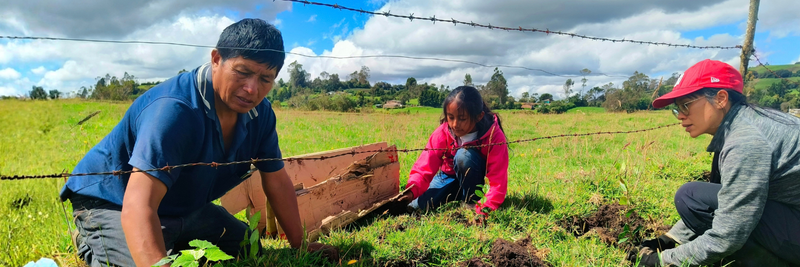
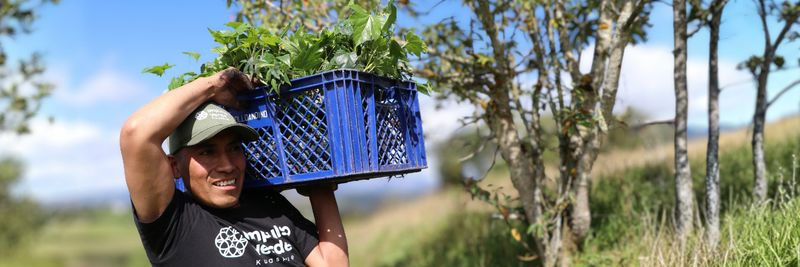
For a decade, Impulso Verde has worked in southwestern Colombia alongside women farmers and Indigenous members of the Pasto people to restore high-Andean forests and páramos through a community-led reforestation model. Since 2024, part of the community reforestation project has been carried out in partnership with the French organization HUMY, with GEF funding through the Inclusive GEF Assembly Challenge Programme, implemented with UNIDO’s support.
Project results:
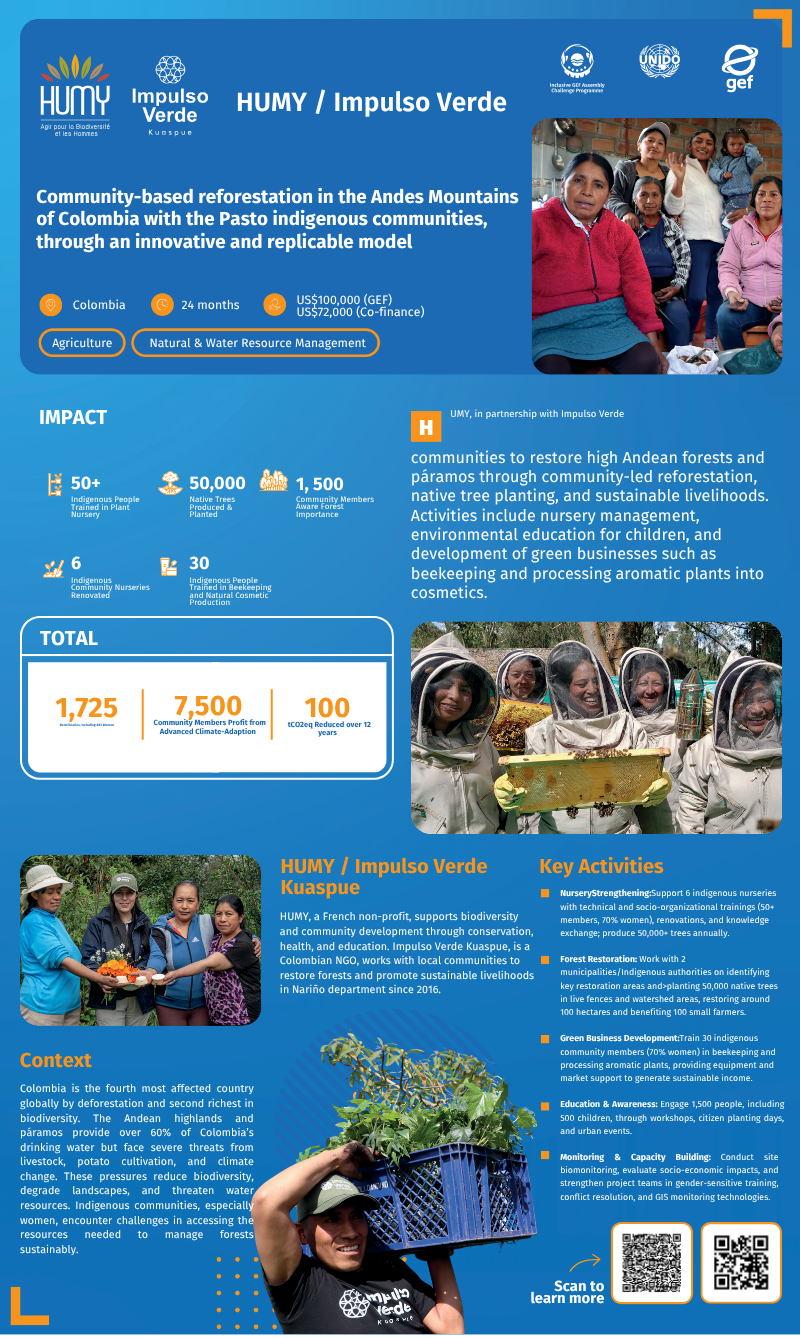
At a territorial scale, this model shows what institutions are now asking to be replicated at large scale: restoring watersheds and páramos creates productive infrastructure, generates income through green businesses, and positions communities, especially women, as stewards of their territory rather than mere beneficiaries of a project.
Call to Action: Partnerships to Invest in Green Infrastructure
Impulso Verde calls on the public and private sectors, investment funds and international cooperation to move toward financing models that bring more capital to the conservation, restoration and sustainable management of territories.
To that end, we propose:
- Blended finance: bringing public, private and cooperation resources together to reduce risk and mobilize capital for environmental projects with verifiable results, with a particular focus on strengthening the ability of community organizations to structure and manage this type of investment.
- Making the most of existing instruments: improving access for conservation and restoration projects to mechanisms such as Payments for Environmental Services, tax benefits for environmental investments, Works for Taxes (Obras por Impuestos) and Habitat Banks, in line with the conditions and scope set for each instrument.
- Partnerships to scale up local experience: connecting international cooperation, the private sector and local organizations to adapt and extend the experience developed in Nariño to other páramo and high-mountain areas facing similar challenges in water security, restoration and adaptation to climate change.
The challenge is not only to mobilize more resources, but to turn them into viable, measurable territorial projects that deliver long-term environmental, economic and social benefits.
Watershed restoration doesn’t compete with industry. It sustains it.
“In Montevideo, we confirmed something we in Nariño have known for 10 years: protecting the páramo is an economic decision, not just an environmental one. We need companies, governments and international cooperation to invest in the communities that are already restoring the land, rather than starting from scratch.” — Antoine Gérigné, President and Founder of Impulso Verde