
PRESS RELEASE
San Juan de Pasto, October 20, 2026
From Community Nurseries to Agroecological Landscapes: Impulso Verde’s Experience at the International Agroecology Congress
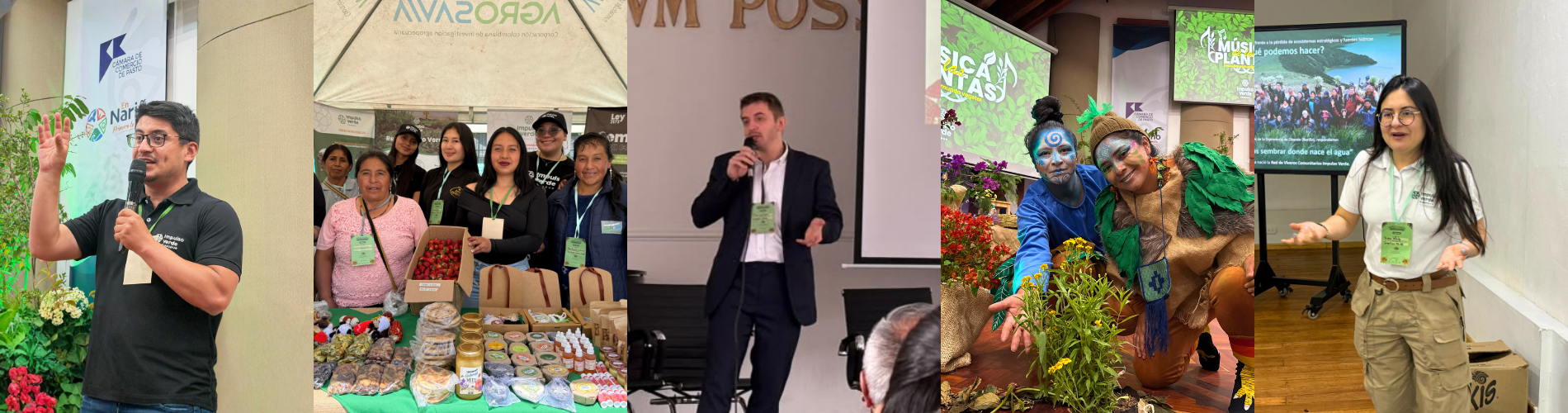
For three days, researchers, rural and Indigenous organizations, and social movements from eight countries gathered in Pasto to discuss how to change the way we produce and eat. Fundación Impulso Verde Kuaspue presented a decade of work with rural and Indigenous communities to recover high-Andean forests, protect water sources and transform production systems. In addition, eight associations from its Community Nursery Network took part in the Knowledge, Flavors and Seeds Fair.
How do we move from a farm that produces food to a territory that also recovers forests, protects water and strengthens the economy of rural families? This was one of the questions Fundación Impulso Verde Kuaspue brought to the 2026 International Agroecology Congress, held October 15–17 in San Juan de Pasto (Nariño).
The event brought together speakers from Brazil, Mexico, Spain, France, Guatemala, Argentina, Ecuador and Colombia, and more than 500 attendees. The agenda included seven presentations, thematic panels, the Knowledge, Flavors and Seeds Fair, the cultural event Music of the Plants, and technical field trips.
At the opening ceremony, Thomas Reginald Preston, a pioneer of sustainable farming and livestock production in the tropics, was honored during his lifetime. From there, the conversations ranged across the major themes of the agroecological transition: food sovereignty, the defense of native and heirloom seeds, public policy, rural education and the restoration of territories.
The contributions from each thematic panel feed into the Congress Manifesto, a collective document that gathers the central ideas of the event.
A Message from Nariño: From Lighthouses to Agroecological Landscapes
The panel “Agroecological Lighthouses and Landscapes,” held on Friday the 16th at the Palatino Auditorium of the University of Nariño, presented six experiences from Colombia and Mexico. The discussion produced a conclusion that will be included in the Manifesto:
“Agroecological lighthouses are born from the territory and grow stronger through networks, like Impulso Verde’s Community Nursery Network, where families, and above all women, decide to plant where water is born and turn pastures into farms that teach. For these lighthouses to become agroecological landscapes, we must bring campesino and ancestral knowledge together with academia, institutions and public policy, and return that knowledge to communities so they can make it their own.”
The panel also left open questions that will stay on the regional agenda: how to link community nurseries to Nariño’s public policy, how to bring restoration to the north of the department in the face of wildfires, how to keep nurseries sustainable beyond the lifespan of individual projects, and how to build, together with producers, a map of the region’s native species.
Impulso Verde’s Results at the Congress
Music of the Plants – Kuaspue: 300 People Listened to the Territory
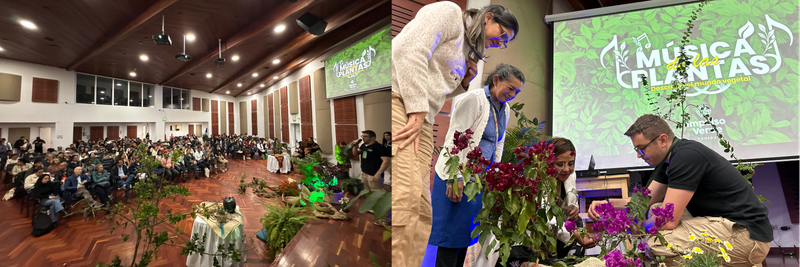
On Thursday the 15th, at the Pasto Chamber of Commerce auditorium, 300 people attended the ensemble performance “Kuaspue: When the Territory Has Its Own Voice.” Sensors connected to the leaves translated the plants’ electrical activity into sound in real time, in dialogue with the story of Kuaspue, the characters of El Chutún and live Andean music. The performance closed the first day of the Congress with an invitation to see the forest as a living being.
Ten Years of the Community Nursery Network
At the panel “We Want to Plant Where Water Is Born,” Diana Villota Cerón, head of the Foundation’s Reforestation Program, presented the results of a decade of community work:
- Since 2016, the network has grown from 3 to 14 community nurseries in Nariño.
- It brings together 200 families, with 70% women’s participation.
- It has planted 1.5 million native trees of 154 species, ten of them threatened.
- It supports the whole cycle: production, planting and geolocated monitoring.
- It leaves lasting capacity in the territory through a kit of 91 technical fact sheets, and is making progress on registering its nurseries with the Colombian Agricultural and Livestock Institute (ICA).
- The model is already being replicated in Valle del Cauca and Magdalena Medio.
She noted that the next challenge is to move from reforesting to restoring.
At the same panel, the Ecoturagro Association, a member of the network, showed the effect at farm scale: in San Joaquín, nearly 120,000 trees planted brought water and wildlife back to pastures that used to dry up, and opened the way for generational renewal. Their message was clear: planting trees doesn’t take space away from the farm.
From Pasture to Agroecological Landscape
On Friday the 16th, at the Teatro Imperial, the Foundation delivered the keynote talk “From Pasture to Agroecological Landscape: A Community-Led Shift in Cattle Ranching,” as part of the “Agroecological Lighthouses and Landscapes” panel. The talk showed how ranching families are making their farms more productive and more resilient to climate change through silvopastoral systems, living fences and fodder banks. It also pointed to the opportunity that aged cheeses offer on the international market as an alternative for cattle farms.
Edible Stories from Gran Cumbal
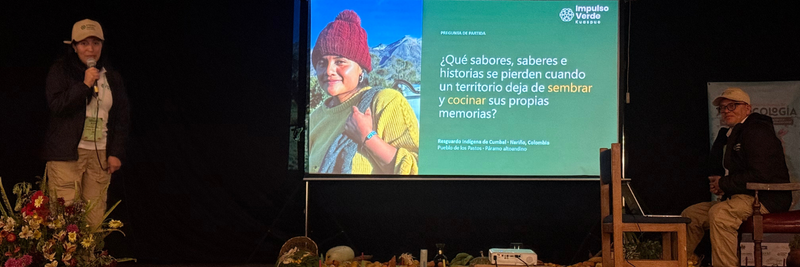
At the “Edible Stories” panel, the Foundation shared the process carried out with 22 families of the Gran Cumbal Indigenous Reserve (Resguardo), which made it possible to recover 15 neglected and underutilized species (NUS) and the culinary memory collected in the booklet “El Chutún: un viaje comestible por el territorio de Cumbal” (El Chutún: An Edible Journey Through the Territory of Cumbal).
Knowledge, Flavors and Seeds Fair: Five Senses and Eight Associations
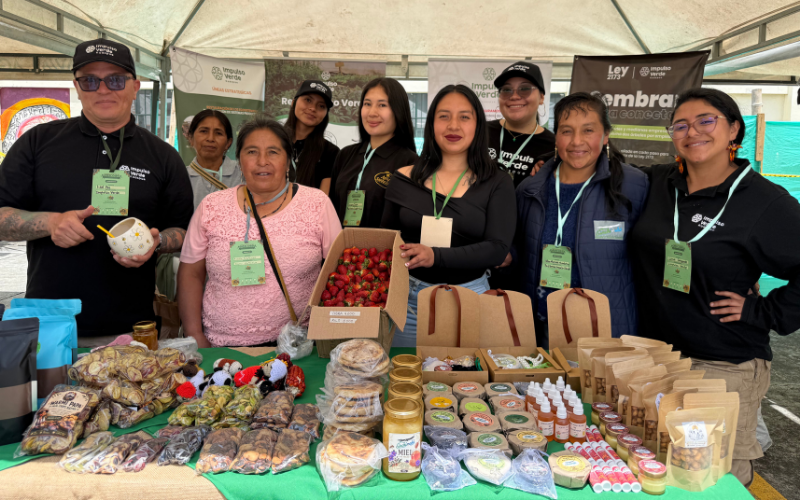
At the Fair, Impulso Verde’s booth offered an environmental awareness experience through the five senses: visitors could touch, smell, taste, see and hear the high-Andean forest, and learn about the work of the Community Nursery Network.
Alongside the Foundation, eight associations from the Network offered and sold their products, a sign that restoration also generates income for rural families:
- Ecoturagro
- Plantando Vida
- San Martín La Vega
- Sinchimaki
- Tulpas Ambientales
- Mujer Emprendedora
- Ancuya
- Pumamaki
“Restoration works when it connects technical knowledge with the knowledge of communities and with the economic opportunities of rural families. In Pasto we shared a decade of lessons from our Community Nursery Network and learned about other experiences showing that it is possible to transform production systems and care for ecosystems at the same time. The challenge now is to strengthen these alliances so that local initiatives can transform entire landscapes,” said Antoine Gerigné, president of Fundación Impulso Verde Kuaspue.
About Fundación Impulso Verde Kuaspue
Since 2016, Fundación Impulso Verde Kuaspue has worked on ecological restoration and the agroecological transition in Nariño, hand in hand with rural and Indigenous communities and a Community Nursery Network that produces, from within the territories, the plant material needed to restore high-Andean forests and protect water sources.